June 12, 2013

Film review. An analysis of the cinematography of Sightseers by Ben Wheatley

Sightseers is a British black comedy by Brighton based director Ben Wheatley (Kill List, Down Terrace); it was screened in the Director's Fortnight section of Cannes Film Festival last year.

The plot. Chris takes her girlfriend Tina, who never left her house and her mother, to a trip around Yorkshire with a caravan. But soon unfortunate events make them become condescending psycho killers.


Cinematography: Laurie Rose
Camera: Red MX
Aspect ratio: 2.35:1
Format: RedCode RAW
Film Stock: -


Ben Wheatly knew Laurie Rose when shooting Down Terrace, which was the first film both of them ever shot; since then Rose has DP'd all Wheatley`s work, including Sightseers. In an interview after the film première, Rose insisted that he was not comfortable with being called cinematographer or DP: he was just a simple cameraman. After watching Sightseers I realized that he was not trying to be just modest:  Sightseers lacks in cinematography. 

Light crew was reduced to a minimum and so were lights used and that can be noticed since the very first scenes, where the image is quite flat and the contrast poor. Light is natural and quite soft, almost shadows free, even in the exteriors, where the typical British overcast days helped to diffuse light. When the sun came out though, we can appreciate some harsh light and strong shadows creating an atmosphere that doesn't really serve the story. 

The camera Rose chose was a Red One with MX sensor, a great camera, but he didn't manage to get the best of it. Throughout the film there are scenes (indoor or outdoor shots) with very bright spots with blown out highlights, which is quite unusual for a camera with 13 stops of dynamic range. Also Roses didn't used many lenses, sticking basically to the 50mm Arri Zeiss and switching to wide angle lenses for landscapes, to keep the natural look of the film, almost shot as it were a documentary. Camera movements are very little used; often camera is hand-held and sometimes placed in very low angles (and perhaps missing a wider angle lens), different and unexpected decisions that never contribute visually to the story. 

It looks like Rose limited himself to expose correctly the scenes, but, as we have seen in past posts, cinematography is much more than this and a correct exposure is not always the right one. Some scenes of Sightseers though are beautifully shot: some foggy landscapes and scenes filmed outdoor at sunrise or sunset, some back-lit, others with wanted gorgeous flares, but all of them with nice contrast and tones and shot with wide angle lenses.

Sightseers is a (literally) bloody good fun but also a bit obvious and predictable, and probably less mysterious and interesting than Wheatley's last work, Kill List.
Cinematography: Emmanuel Lubezki
Camera: Arricam LT, Arriflex 235, Panavision, Red MX,
Lenses: Arri Zeiss Master Prime
Aspect ratio: 2.35:1
Format: 35mm, 65mm, Redcode RAW
Film Stock: Kodak 5218
- See more at: http://donatelloromanazzi.blogspot.com.es/2013/06/film-review-analysis-of-cinematography.html#sthash.1odzoTYW.dpuf

Cinematography: Emmanuel Lubezki
Camera: Arricam LT, Arriflex 235, Panavision, Red MX,
Lenses: Arri Zeiss Master Prime
Aspect ratio: 2.35:1
Format: 35mm, 65mm, Redcode RAW
Film Stock: K
- See more at: http://donatelloromanazzi.blogspot.com.es/#sthash.KI6SyFZy.dpuf

Cinematography: Emmanuel Lubezki
Camera: Arricam LT, Arriflex 235, Panavision, Red MX,
Lenses: Arri Zeiss Master Prime
Aspect ratio: 2.35:1
Format: 35mm, 65mm, Redcode RAW
Film Stock: K
- See more at: http://donatelloromanazzi.blogspot.com.es/#sthash.KI6SyFZy.dpuf

Cinematography: Emmanuel Lubezki
Camera: Arricam LT, Arriflex 235, Panavision, Red MX,
Lenses: Arri Zeiss Master Prime
Aspect ratio: 2.35:1
Format: 35mm, 65mm, Redcode RAW
Film Stock: K
- See more at: http://donatelloromanazzi.blogspot.com.es/#sthash.KI6SyFZy.dpuf

Cinematography: Emmanuel Lubezki
Camera: Arricam LT, Arriflex 235, Panavision, Red MX,
Lenses: Arri Zeiss Master Prime
Aspect ratio: 2.35:1
Format: 35mm, 65mm, Redcode RAW
Film Stock: K
- See more at: http://donatelloromanazzi.blogspot.com.es/#sthash.KI6SyFZy.dpuf
Cinematography: Emmanuel Lubezki
Camera: Arricam LT, Arriflex 235, Panavision, Red MX,
Lenses: Arri Zeiss Master Prime
Aspect ratio: 2.35:1
Format: 35mm, 65mm, Redcode RAW
Film Stock: Kod
- See more at: http://donatelloromanazzi.blogspot.com.es/p/film-review.html#sthash.tIPS4wjN.dpuf
Cinematography: Emmanuel Lubezki
Camera: Arricam LT, Arriflex 235, Panavision, Red MX,
Lenses: Arri Zeiss Master Prime
Aspect ratio: 2.35:1
Format: 35mm, 65mm, Redcode RAW
Film Stock: Kodak 5218 500T, Kodak 5217 200T, Kodak 5219 500T
- See more at: http://donatelloromanazzi.blogspot.com.es/p/film-review.html#sthash.tIPS4wjN.dpuf
Cinematography: Emmanuel Lubezki
Camera: Arricam LT, Arriflex 235, Panavision, Red MX,
Lenses: Arri Zeiss Master Prime
Aspect ratio: 2.35:1
Format: 35mm, 65mm, Redcode RAW
Film Stock: Kodak 5218 500T, Kodak 5217 200T, Kodak 5219 500T
- See more at: http://donatelloromanazzi.blogspot.com.es/p/film-review.html#sthash.tIPS4wjN.dpuf

June 10, 2013

How they did it. Shooting Game of Thrones

Game of Thrones is the HBO TV series everyone is talking about, but, have you ever wondered how they shot it? 

Shooting Game of Thrones

Like every production of its genre different directors and cinematographers have been working in different episodes: the challenge was to match visions and maintain a certain consistency to the whole series. This task wasn't easy at all, considering that the story develops in dissimilar locations spread from the snowed north down to the sunny south and the shooting time they had was almost the same  of a one location TV series: about 18 days per episode.

During the preproduction, several tests were made to chose the best camera possible to achieve functionality and good quality; this time digital won the battle with film: Arri Alexa camera was chosen for its characteristics similar to films, details in highlights, noiseless images in very low light conditions (Alexa recommended ISO is 800) and of course the quickness of delivering and watching dailies (raw, unedited footage of the shooting day). As I said, Games of Thrones was shot in different locations (Iceland, Northern Ireland, Croatia, Malta, Morocco...) because every kingdom has its own climate and environment; this wouldn't have been possible if they didn't have two units shooting simultaneously: dailies and flip books with screen shoots of the scenes and locations were absolutely necessary and consulted by cinematographer to give consistency to the shooting. 

Above, the original frame. Below, after VFX
Every kingdom has a different look: blueish and cold for the Wall, a sort of Mediterranean feel for King's Landing, harsher light in Red Waste and Quarth; but the way of shooting and lighting is basically the same. The camera is often hand held, crane and dolly are used but not excessively, the focal length of the lenses (they used Cooke S4 and Angenieux Optimo zoom lenses) is normally between 21mm and 85mm. Light is natural but expressionistic: windows, doors, fireplaces, candles, etc. are used as light-sources but light is always exaggerated making the scene more dramatic.  Low light scenes are abundant: lots of scenes were lit just with candles taking advantage of Alexa´s characteristics; or, especially in the scenes shot in the snowed woods of the North,  Wendy lights mounted on high cranes were used to simulate the light of the moon. Quite often the Key light is place behind the actors, shot in back-light. 

Above, the original frame. Below, after VFX
The art direction department made a great work creating a new world from the scratch, inspiring themselves in different cultures from modern and past time achieving a really believable result. Another aspect which gives credibility to the scenes and the whole series is the use of visual and 3D effects created by the Irish VFX company Screen Scene, which, apart from animating dragons and other creatures, changed and beautified landscapes and castles, multiplied people and objects and made battles far more spectaculars.
Game of Thrones managed to gather more and more public throughout the 3 seasons and today, Monday 10th of June, season 3 finale will be aired. But their fans should not wait too long for new episodes: the filming of season 4 will start on July.

June 09, 2013

Iconic Bcn Fashion Shooting and "making of" photos


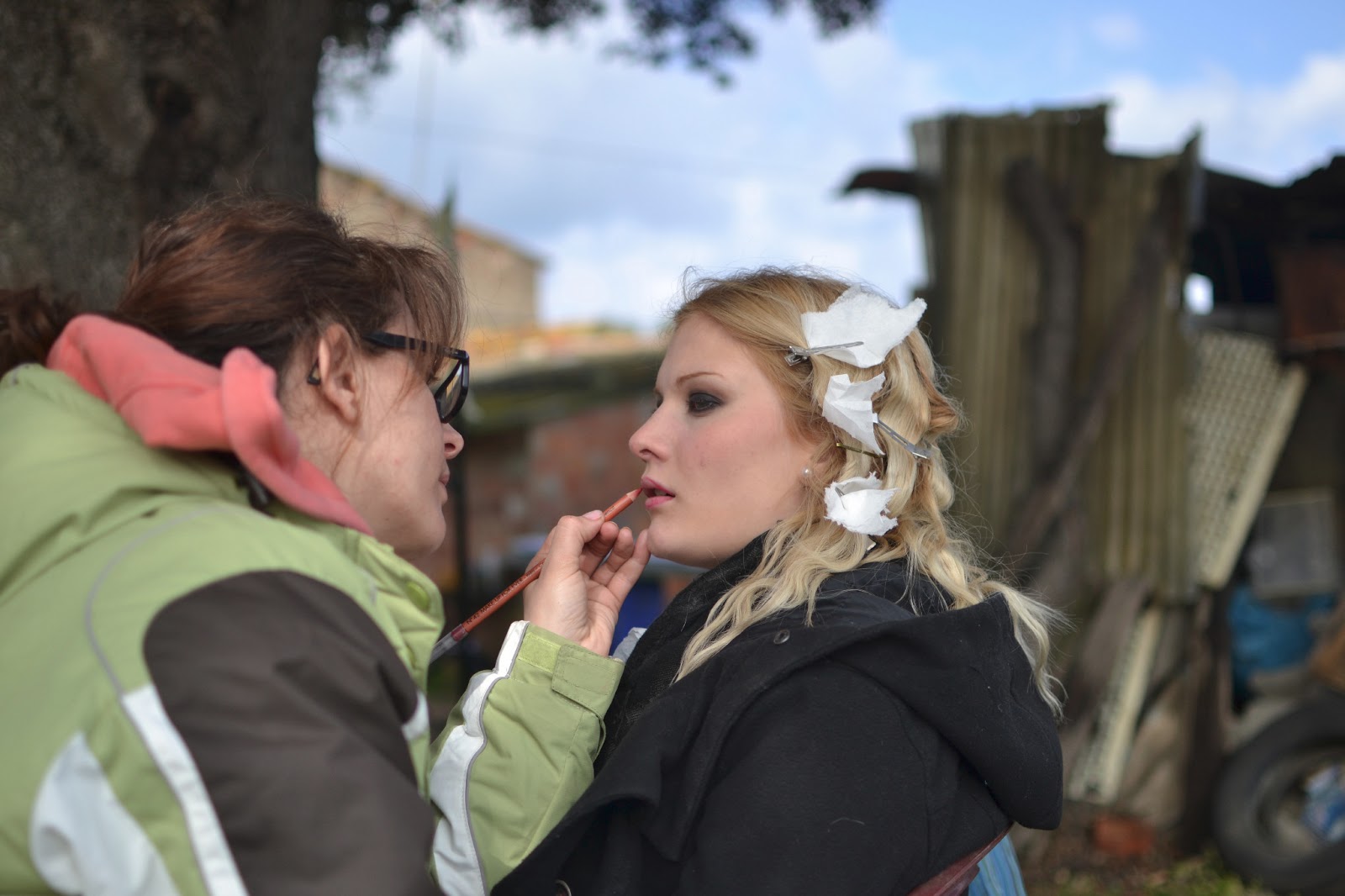
Here's some photos of the recently published fashion shooting we did in the countryside for Iconic Bcn. I wrote an "How I shot it" post with a light diagram of the image on the right,  you can read it here.

Make up and light metering were crucial for this shooting because the camera used was an analogue one and the images didn't go through Photoshop.


June 07, 2013

Know light. Use of natural light indoor

If you are shooting indoor you do not always need  artificial light to expose your pictures: you can do a magnificent job using just available natural light. You just need a room with a window and sun light, of course.  You could use the window as a back (or rim) light to create a silhouette of your subject or you can move around and use it as side light: depending on if you expose for the mid-tones or the brighter side of the subjects, you'll get different results.

A reflector or a white board might be very helpful: it's perfect to bounce and soften the light to create a more delicate mood or to fill up shadows; but be careful with the kind of white you are using! some materials, for its composition or the way they have been washed, produce ultraviolet light, resulting in a blue cast in the image. Depending on where the reflector is positioned it will create a different atmosphere. If it is held in a higher position, imitating the sun,  the look will be very natural, if it is held down bouncing up the light, it will create a more artistic effect.

I prefer using north light when shooting indoor because it's softer and I don't have to deal with heavy deep shadows; however there are situations when direct sunlight is more suitable: when you want to play with high contrast or with shadows of the window drawn on the subject, for example.

As always, the key of photographing indoor with natural light is to stay creative: you have to move around, not only to get the best composition, but to see how the characteristics of light change; you have to play with light and shadow, stay alert and take advantage of opportunities: a single ray of light passing through a window slightly ajar it's enough to shoot a stunning image.

June 06, 2013

The other Ireland. Boats in Castle Cave.


The Ring of Kerry, Ireland, is full of beautiful places. But, if You leave the main road (and jump some fences..) You can find another Ireland, a different and hidden one, probably less idyllic but not for this less spectacular,  like these two boats waiting for the high tide in Castle Cave.

June 05, 2013

Film review. An analysis of the cinematography of To the Wonder by Terrence Malick

Few days ago I had the opportunity to watch again To the Wonder, a film by Terrence Malick who needs no presentations: The tree of Life, The thin red Line, The new World, Badlands are some titles of his filmography. It was a great delight to enjoy once again the work of one of the best cinematographer of the present time: Emmanuel Lubezki.

The plot. An American falls in love with a divorced girl living in Paris. She follows him and settles in Oklahoma but problems arise in their relationship. Meanwhile, a priest struggles against his faith.


Cinematography: Emmanuel Lubezki
Camera: Arricam LT, Arriflex 235, Panavision, Red MX,
Lenses: Arri Zeiss Master Prime
Aspect ratio: 2.35:1
Format: 35mm, 65mm, Redcode RAW
Film Stock: Kodak 5218 500T, Kodak 5217 200T, Kodak 5219 500T

Terrence Malick relies once again on the cinematography of Emmanuel Lubezki whose filmography is quite extensive ( Ali, The New World, Sleepy Hollow, Meet Joe Black, Y tu mamá también...). As he already did it in The Tree of Life, the mexican cinematographer only makes use of natural light for filming To the Wonder, using just bouncers and blockers. According to him, "natural light is more complex than artificial light and once you master it, it is hard to go back and illuminate a scene artificially". He not only did an excellent job with that but also taught (or reminded) everyone that everything has to serve cinematography to visually tell a story in the best way possible: not only trough light, costumes design and colours, lenses and camera movements, but even trough the film stock, the camera itself and the format used.

Throughout the film, Lubezky always seeks back-light; in the exterior shots the sun is always low in the horizon and quite often in frame, he plays with it, positioning the actors between it and the camera, avoiding the silhouette and shooting them shadow free, and looking for light spills and flares every time they move, overexposing some areas of the frame. In the shots taken indoors the back light is more extreme: he uses doors and windows as light sources and the actors are dense black silhouettes. Shooting indoor must have been complicated: with light changing constantly Lubezki only had few useful hours in every location. They shot fast and they shot a lot, because they didn't have to "waste" time moving lights, and probably shot some hours in a house and some hours in an identical one but architecturally different to take advantage of the entire shooting day.
In the few night time shots, available light of lamps is used: they are always in frame and overexposed, creating great contrast in the scene.

Five different cameras were used to shoot To the Wonder. The film starts with some images of the couple in a train taken with a digital camera full of digital artifacts but it does remind a super-8 camera and the feeling of holiday and happy memories, like the beginning of a relationship. When Marina (Olga Kurylenko) goes back to Paris, Lubezki follows her alone in the street at night using a Red MX, giving a sense of modern and urban life (in contrast with the Oklahoma surroundings) as well as a sense of cold solitude. All the rest of the film is shot in 35mm apart from the scenes where Ben Affleck starts a relationship with an old friend, Rachel McAdams: here the 65mm negative is used. This relationship is less romantic but more stable than the one with Marina: for Lubezki the 65mm reflects this more realistic stability.
Camera is rarely static: always flowing with the characters, mostly following them, on a steady-cam or hand-held, and always going forth, suggesting the idea that life always goes on. Lubezki chose, as in The Tree of Life, Master prime lenses which offer a very clean and sharp image, mostly using wide angle lenses, achieving a very great depth of field which suits perfectly Malick's way of directing especially because the director rarely leads the eye of the spectators toward the actor, and offers them the whole frame instead.
Terrence Malick is a peculiar director with a peculiar style pretending to make poetry with images. You can like his style or hate it. And To the Wonder is no exception. The movie was shot without a script, almost has no dialogue and no plot nor action: it is absolutely visual, showing moments of the life of a couple and it's up to the spectator to shape a story. Whatever you like his style or not, To the Wonder is a cinematographic piece of art which confirms Lubezki as one of the best living cinematographer capable of creating stunning beautiful images and a visual storytelling second to none. To the Wonder is an exquisite visual experience, completed with great music and editing,  that will undoubtedly be in this year top five best cinematographies.


June 03, 2013

How I did it. Outdoor black and white Fashion shooting

When we were preparing this fashion shooting, there was one thing my Art Director, Gemma, and I had clear in mind: contrast. So we decided to develop the entire shooting around it. Models, locations, dresses, attitude... everything should reveal the idea of contrast. Once again I chose a Medium Format analogue camera because, apart from being my favourite photographic format, it was the perfect combination with the idea we developed.


Tmaxx 400, ƒ11 t1/125

Two elegant ladies in the countryside, in a filthy and decaying place far from the town where they can freely love themselves in a less platonic way. It's around 1920, as the hair style suggests; the ladies could be an aristocratic woman and her servant... This is, briefly, the story we told trough the shooting. I wanted the images to remind the feel of that time, that's way I shot analogue and that's why I used black and white film.

I chose the film I am most comfortable with, Tmax 400 and a 80mm lens on a medium format camera to respect the naturalism of the whole idea. I used just two lights for the shooting; well, actually three lights if we count the light of the overcast day we had which played as ambient light.


The key light was positioned behind the models, at camera right: it was a naked flash so the light would have scattered all over the place imitating the sun. In front of the models, on camera left, I placed the fill light: a huge octagonal softbox 150cm wide which provided soft and diffused light wrapping the models and able to illuminate both of them. I placed it on one side because the shadows it produced on the blonde model's face were very suitable for her physiognomy.

I used a Y8 filter to whiten the blond model's skin and to accentuate the contrast of the scene. Even if I love grain, this time I controlled the agitation during the negative development because I looked for the fine grain the Tmax offers and played with the time of the process to enhance the contrast.

You can see the whole shooting in my web or in Stravagance Magazine.